Why Repo Nexus?
Modern engineering teams face an architectural dilemma: manage code across dozens of autonomous Git repositories, or consolidate everything into a monolithic repository (monorepo). Both approaches introduce friction as teams and AI coding assistants scale.
Repo Nexus provides a third path: the Virtual Meta Repository (meta repo) and Nexus Repository (nexus repo).
What is a Meta Repository (Meta Repo)?
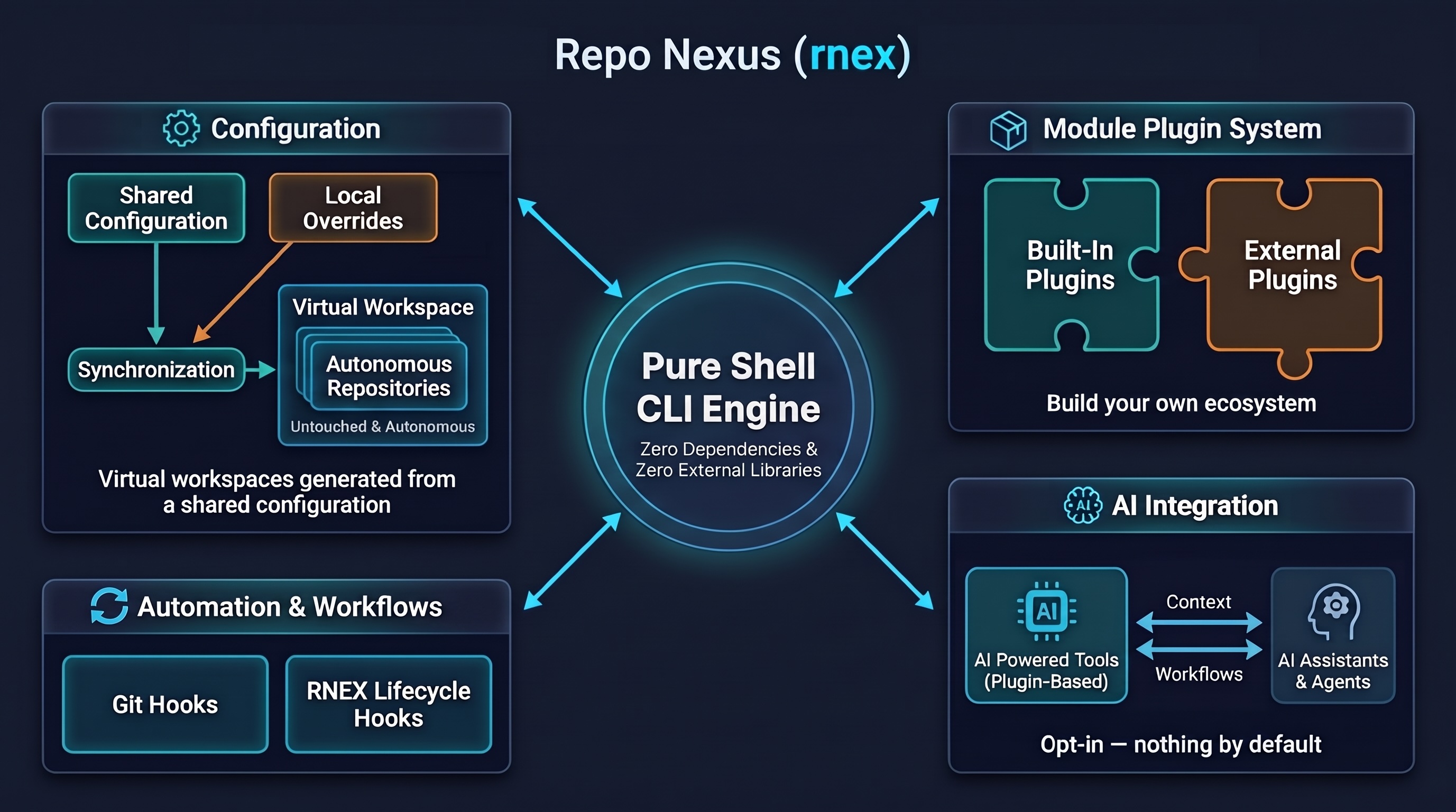
A meta repository (meta repo) is an architectural pattern where an umbrella repository acts as a single coordination and onboarding point for multiple independent Git repositories. Rather than compiling all code into one giant monorepo, a meta repo coordinates member repositories as distinct, isolated Git checkouts within the workspace.
What is a Nexus Repository (Nexus Repo)?
A nexus repository (nexus repo) serves as the central junction for configuration, team conventions, cross-repo tooling, and unified AI context. In repo-nexus, the nexus repo ensures that AI agents (Cursor, Claude Code, GitHub Copilot, Codex, Gemini, Windsurf) have a consistent understanding of all member repositories without leaking cross-repo state or requiring custom monorepo tooling.
The Multi-Repo Dilemma
Why Teams Resist Full Monorepos
- Access Control & Permissions: Monorepos grant all-or-nothing repository read/write access unless complex enterprise tooling is deployed.
- Massive CI/CD Overhead: Monorepo pipelines require specialized caching systems (Turborepo, Nx, Bazel) to avoid rebuilding unaffected projects.
- Migration Friction: Moving independent repositories into a monorepo destroys historical Git branches, tags, open pull requests, and established CI configurations.
Why Git Submodules Fail
Git Submodules attempt to link independent repositories together, but introduce well-known operational traps:
- Detached HEAD State: Checking out a parent repository leaves submodules pinned to specific commit SHAs, leading to accidental uncommitted work.
- Pointer Desynchronization: A developer updates a submodule but forgets to commit the parent pointer, breaking builds for colleagues.
- Complex Branching: Branch switching in the parent repository does not track branch changes in submodules automatically.
- AI Context Blindness: AI assistants and editor language servers struggle with submodule boundaries and nested
.gitdirectories.
Nexus Repo vs Git Submodules: Why Virtual Orchestration Wins
Repo Nexus acts as a lightweight coordinator around your repositories without altering their autonomous Git state:
- Zero Submodule Tracking: Member repositories clone into
<repos_dir>/<name>/(default./repos/<name>/) as standard, autonomous Git repositories. The umbrella meta-repo never tracks submodule pointers. - Complete Git Autonomy: Branch, commit, rebase, and push directly inside each member repository (
cd <repos_dir>/backend && git commit). - Unified Workspace View: Work in a single editor instance with multi-root workspace support (
.code-workspace) and run batch operations across all repositories viarnex exec. - Universal AI Context Routing: AI rules, skills, and instructions are scoped and mirrored across Claude, Cursor, Codex, Gemini, Copilot, and Windsurf formats automatically.
Architectural Comparison
| Dimension | Git Submodules | Monorepo (Nx / Turborepo) | Repo Nexus (rnex) |
|---|---|---|---|
| Repository Model | Nested Git trees | Single giant repository | Virtual Meta-Repo umbrella |
| Git Complexity | High (detached HEAD, pointer sync) | Low (single git log) | Zero (standard independent repos) |
| Migration Cost | High | Massive (rewrite git history) | Instant (rnex init & rnex repo add) |
| Runtime Dependencies | Git | Node.js, Rust, or Go runtimes | Pure POSIX /bin/sh (zero deps) |
| AI Context Scoping | Manual per repo | Root-level bleed | Delimited, multi-provider mirroring |
| Local Developer Overrides | Hard / dirty git status | Difficult | Native via .local.rnex.yaml |
Summary
Repo Nexus gives you the developer experience and shared AI context of a monorepo while retaining the isolation, security boundaries, and modularity of an autonomous multi-repo architecture.